Land as Old-Age Security: How Land Titling Reshapes Rural Labor Supply in China
With Luoqi Yuan and Jianjun Tang
Revise and resubmit (second round), Journal of Population Economics
Presented at GLO-JOPE Conference 2025; 17th CHLR Symposium on Human Capital and Labor Markets; Labor Science Education Committee Annual Meeting 2026 (Academic Rising Star Award)
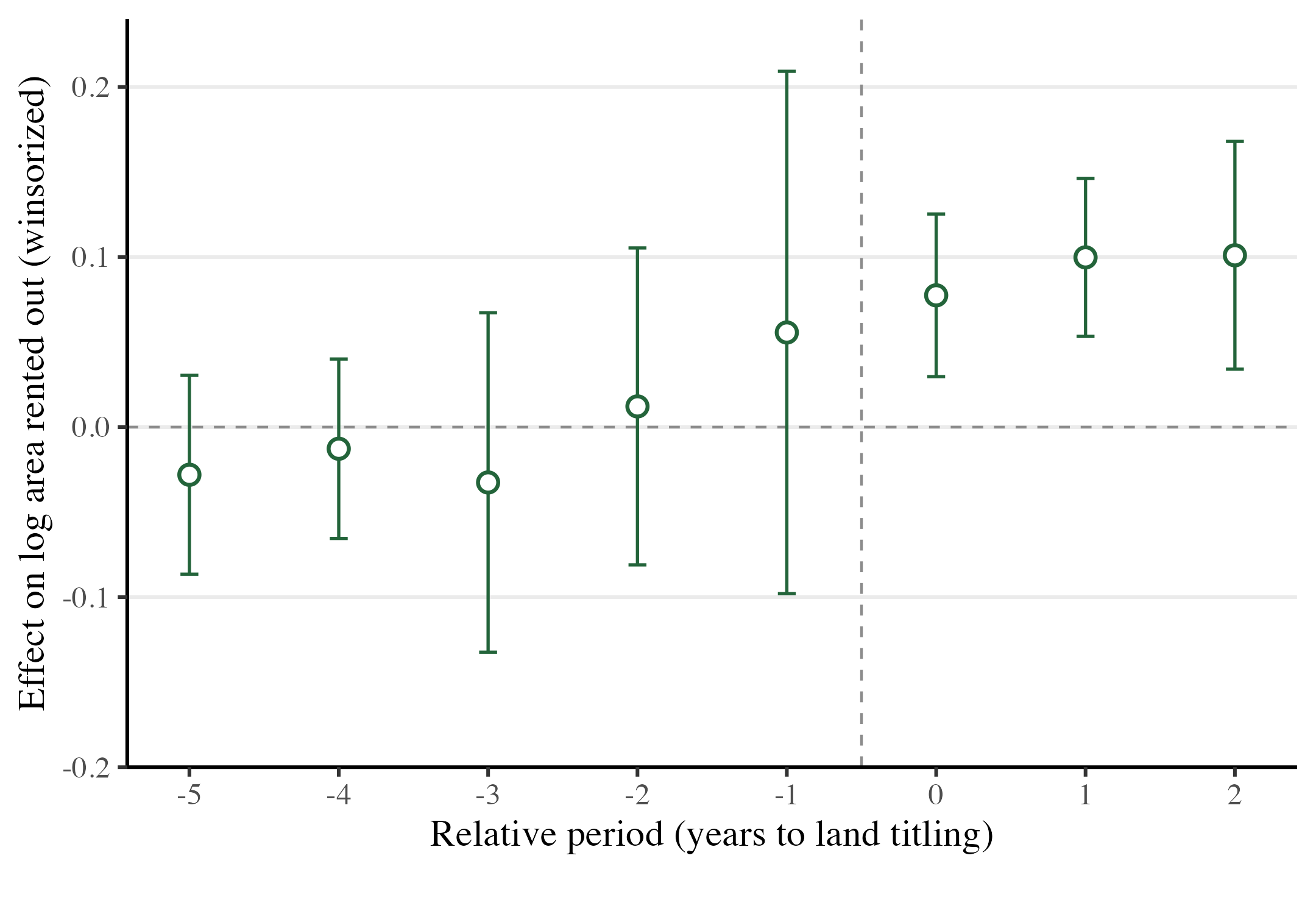
Rural workers in China face no statutory retirement age and thin pension coverage, and most of their wealth is in land that cannot be sold. We show that land titling lets older adults turn this land into income without farming it. Using the national rollout and CHARLS panel data, we find that titling lowers labor-force participation by 3.2 percentage points and increases the land households rent out. Adults past 60 leave the labor force, while those aged 45 to 59 stay employed and move out of farming. A reform that transfers no money can work like a pension.